Invisible Bottlenecks in API Latency
A practical dive into why API latency sneaks up on you in microservice architectures, common invisible bottlenecks, and how modern teams can trace, detect, and bust them before users even notice.
In the era of distributed systems, microservices are hailed for their scalability, resilience, and modularity. However, this architectural freedom comes with a hidden cost—API latency.
A seemingly insignificant delay in one service can propagate and amplify through an entire request chain, degrading the user experience.
What Is API Latency?
API latency is the time it takes from when a client sends a request to when it receives a response. This includes:
- Network latency (transmission time)
- Queueing delay (waiting for a thread)
- Processing time (backend logic)
- Dependency delay (downstream service calls)
Microservices and the Domino Effect
In microservice architectures, a single user request often triggers multiple downstream API calls across different services.
A 300ms delay in Service A might not seem problematic—until you realize it’s called 20 times per transaction.
Example: Chained Latency in an E-commerce App
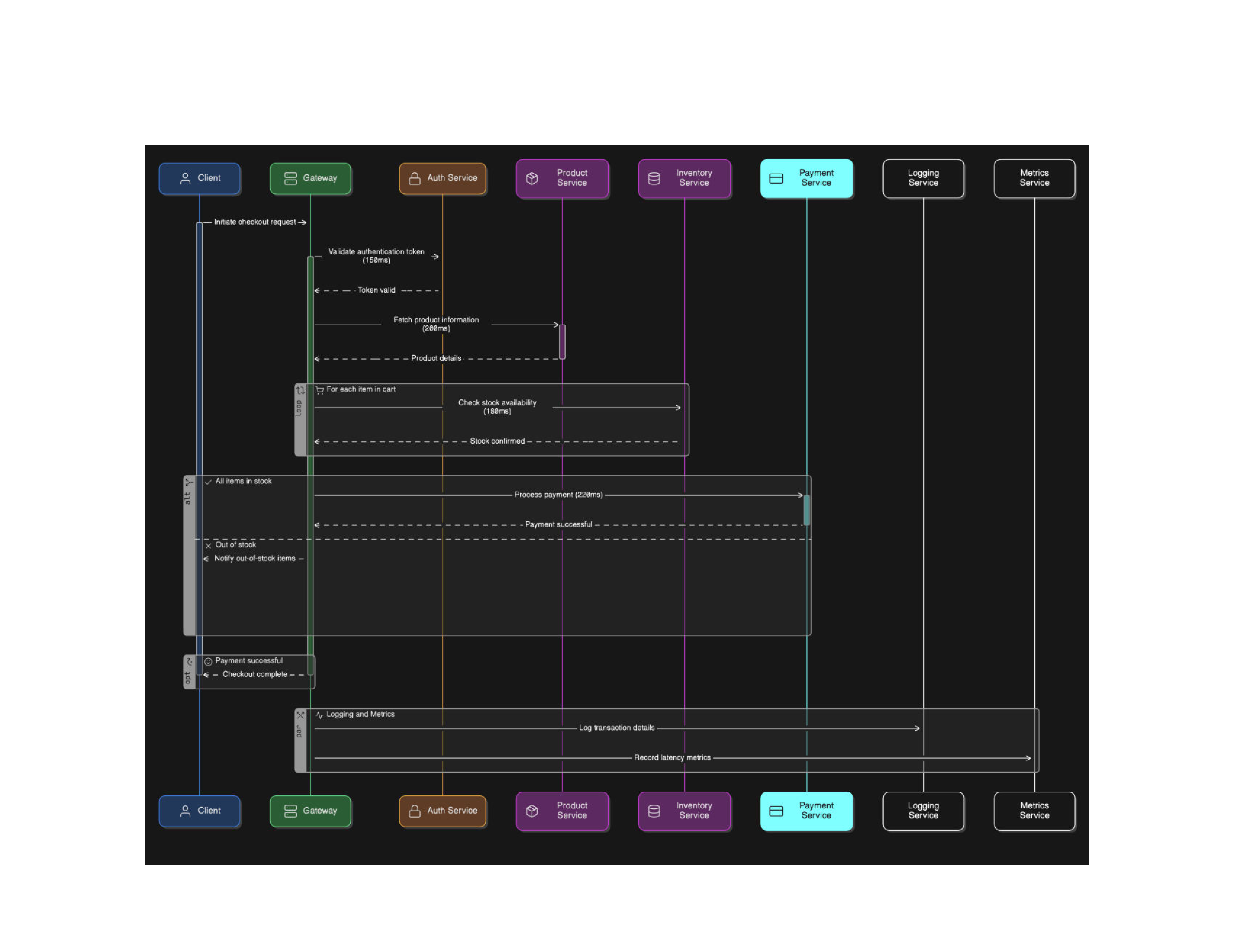
And this doesn’t include the Gateway’s own processing or retry overheads!
Compounding Latency: The N+1 Problem
Sometimes, services don’t just call one downstream API—they call many, often in loops or dynamically.
Example:
  # N+1 API problem in pseudocode
  for product_id in cart:
  stock_info = call_inventory_service(product_id)
Calling 10 products individually instead of batching can cause latency to skyrocket.
Tools to Detect Latency Bottlenecks
- Distributed Tracing – Tools like Jaeger, Zipkin, or OpenTelemetry can trace API paths and identify where time is spent.
- APM Platforms – Datadog, New Relic, Dynatrace visualize latency hotspots in real-time. Custom Metrics – Log latency by endpoint and status to surface slow interactions.
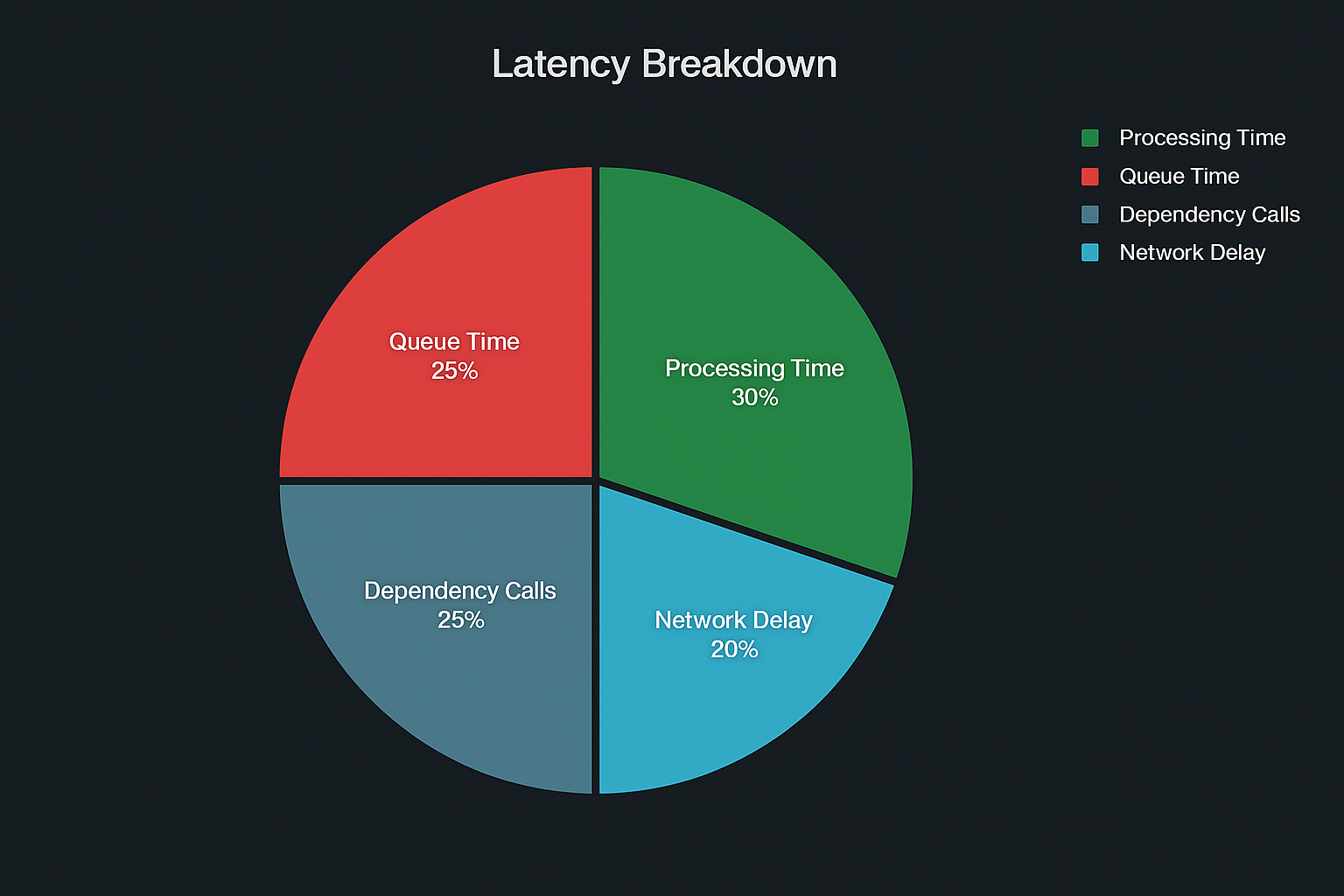
Visual: Latency Breakdown Across Services
Best Practices to Tame API Latency
- Use Async/Non-blocking IO wherever possible.
- Batch Requests to minimize N+1 calls.
- Use Caching for repeatable data like product catalogs.
- Timeouts + Circuit Breakers (Hystrix, Resilience4j) to isolate failures.
- Deploy Near Users – Reduce cross-region network delays.
Final Thoughts
Microservices give us incredible flexibility—but with great decoupling comes great responsibility. Monitoring and optimizing API latency is critical to delivering snappy, reliable systems.
Bottlenecks aren’t always visible in code—they’re hidden in the wires between services.
Keep reading
All posts- event-driven architecture
· 10 min read
Event-Driven Architectures & Message Queues: Why Modern Systems Rely on Events, Not Direct Calls
Learn how event-driven architecture and message queues decouple services, improve scalability, and build resilience in modern systems. Explore real-world examples, patterns, and tools like Kafka, RabbitMQ, and CQRS.
By Shaheer Asrar
- caching
· 10 min read
Caching Strategies That Scale
A deep-dive into designing, implementing, and operating caches that make systems faster, cheaper, and more reliable. Learn multi-level caching, core patterns like cache-aside and write-through, stampede protection, invalidation strategies, and real-world code examples with Redis and Python.
By Shaheer Asrar
- cognitive debt
· 6 min read
Cognitive Debt: The Hidden Cost of Letting AI Write Your Code
Cognitive debt is the new tax on AI-assisted development—a quiet erosion of shared understanding that paralyzes teams long before technical debt does. Here's what it is, why it matters more than tech debt right now, and how to keep your team's mental model of a codebase intact.
By Abdullah Waqar